LEARN
Lighting for life: What turtle hatchlings can teach us about responsible lighting
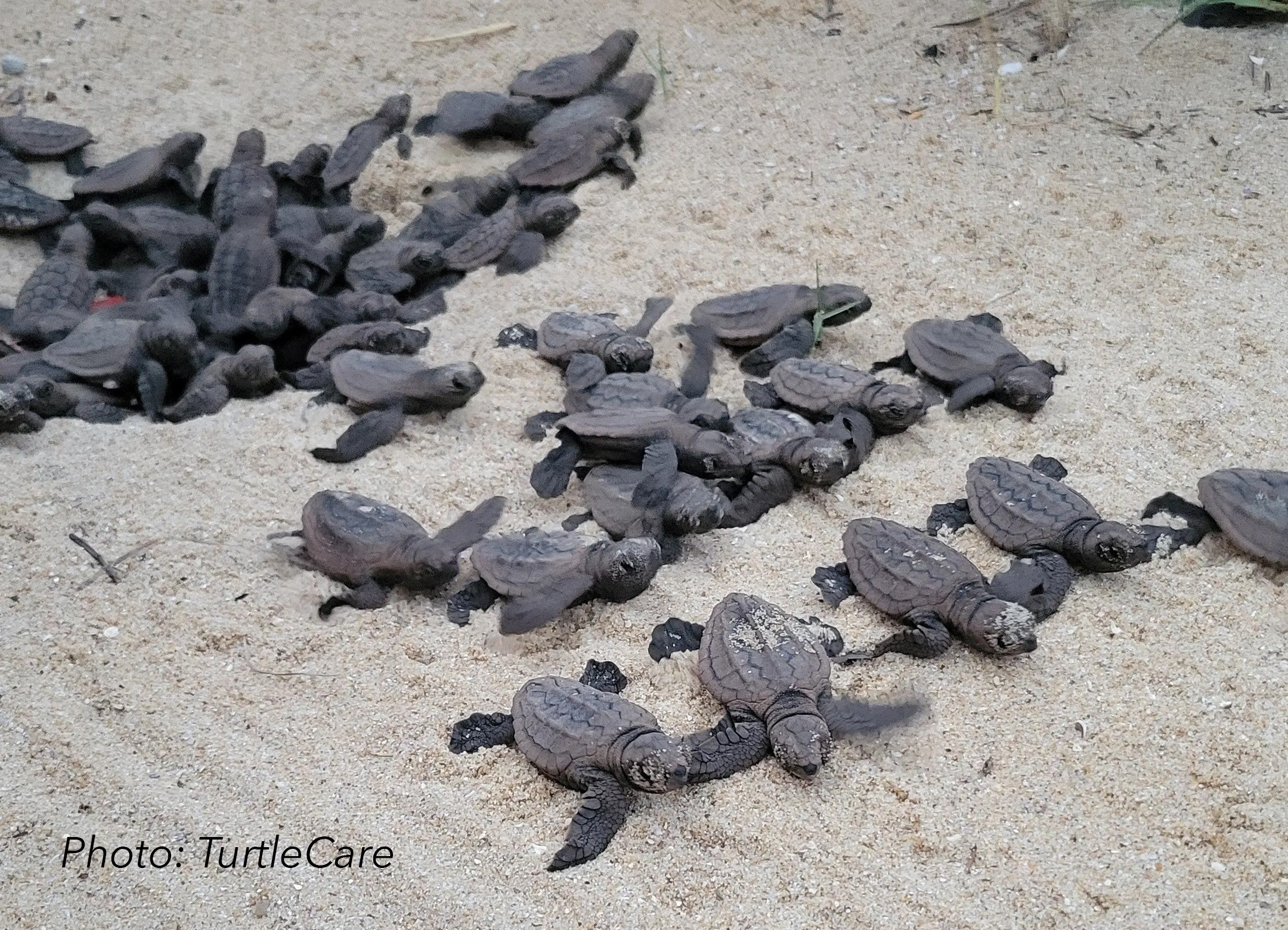
Each summer, marine turtle hatchlings break free from their nests and instinctively head towards the ocean. But artificial light at night (ALAN) is making this journey increasingly dangerous, with hatchlings often becoming disoriented and heading inland instead of seaward.
A new peer-reviewed study, published in Wildlife Research, has provided clear evidence on how different LED streetlights affect this critical stage of turtle survival (King et al. 2025)1. WE-EF LIGHTING was proud to provide luminaires for this important research.
What the Study Found
Researchers tested commercially available LED streetlights at Mon Repos Conservation Park in Queensland, a globally significant nesting site. The results were striking:
• Narrow-spectrum red LEDs (625 nm): Did not significantly disrupt sea-finding behaviour, even at higher intensities.
• Phosphor converted (PC) amber LEDs: Less disruptive than broad-spectrum LEDs (likely due to the near absence of blue wavelengths). Flatback and loggerhead hatchlings were largely unaffected, but loggerhead hatchlings still showed misorientation at higher intensities.
• Broad-spectrum LEDs (2500K–3000K): Consistently disruptive due to their blue wavelength emissions.
Not all species respond the same way
The research reinforces an important ecological principle: different species respond differently to light. Flatbacks and loggerheads reacted in different ways to the same spectrum and this variation extends far beyond turtles – to seabirds, bats and insects.
This means lighting strategies must be context-specific. In many cases, PC amber is a practical improvement. But in particularly sensitive habitats, true amber or red narrow-spectrum LEDs – or removing artificial light altogether – may be necessary.
Lighting responsibly: More than just spectrum
At WE-EF, we believe spectrum is only one part of the solution. Responsible lighting also means:
• Optical precision: placing light exactly where it is needed, for people and places.
• Shielding and direction: not only preventing upward light spill altogether, but also looking at options for sidelight and backlight shielding in sensitive applications.
• Smart controls: using technology so lights operate only when required – for example, presence-based activation and dimming during quiet hours.
By combining spectrum choice with optical design and control, we can deliver lighting solutions that enhance human amenity, reduce energy use, and protect wildlife.
Looking ahead
As light pollution grows worldwide, studies like this are critical. They provide policymakers, councils and designers with evidence to make smarter, site-specific lighting decisions. At WE-EF, we are proud to contribute to this growing body of knowledge and to keep pushing for lighting that balances human needs with environmental responsibility.
Read the full study here
References
- King Ebony J., Hofmeister Kate M., Bosshard Simone C., Limpus Colin J.,
Scales Kylie L. (2025) To sea in the dark: assessing effects of LED streetlights
on sea-finding in marine turtle hatchlings.
Wildlife Research 52, WR24151
↩